Mon - Sat 10:30 AM - 04:30 PM Sunday Closed
Call Us - +91 98880 89761 info@kidneytransplantchandigarh.com

Mon - Sat 10:30 AM - 04:30 PM Sunday Closed
Call Us - +91 98880 89761 info@kidneytransplantchandigarh.com
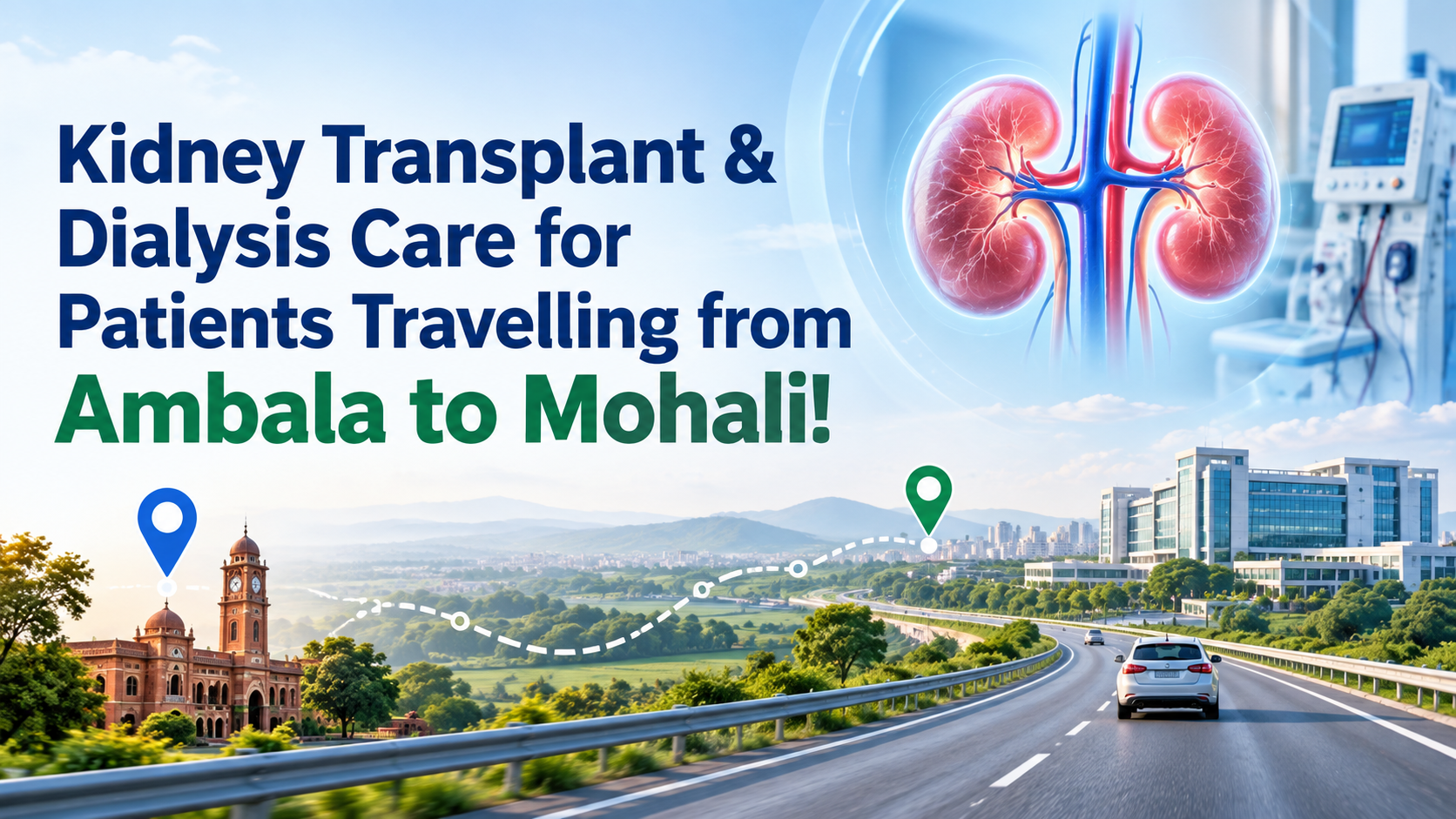
One of the most difficult aspects for patients dealing with advanced kidney disease is finding the right medical care. And why not, the process is not as simple as it might seem. There are regular consultations, dialysis, investigations, transplant evaluation and long-term follow-up that are all needed to be planned carefully.
If you or any of your loved ones are dealing with kidney health issues and are a resident of Ambala or the surrounding areas, Mohali can be one of the practical destinations for specialized nephrology and kidney transplant care. Ambala is an important gateway city connecting Haryana, Punjab and Himachal Pradesh, and the Kidney Transplant Chandigarh currently places the distance from Ambala to its Mohali centre at approximately 45 km, with a typical road journey of around an hour. Obviously, the actual travel time can vary with traffic, weather and road conditions. This relatively manageable distance can be particularly relevant for patients who need repeated visits, dialysis or regular post-transplant monitoring.
Whether you have recently been diagnosed with chronic kidney disease (CKD), are already receiving dialysis or have been advised to consider transplantation, understanding the treatment pathway can help you plan with greater clarity. Our blog today explains what Ambala patients should know about kidney transplant Ambala options, nephrology care, dialysis, transplant evaluation, travel planning and the costs involved.
Kidney disease can develop gradually and may cause few noticeable symptoms in its early stages. Diabetes, high blood pressure, inherited kidney disorders, autoimmune diseases, recurrent kidney problems and previous acute kidney injury can all contribute to reduced kidney function. An abnormal creatinine or eGFR report does not automatically mean that a patient needs dialysis or a transplant. It does, however, deserve appropriate medical evaluation.
A nephrologist may recommend:
Early evaluation gives doctors an opportunity to identify potentially treatable causes and manage factors that could contribute to further kidney damage. It also gives families more time to understand what may be required if kidney function continues to decline.
A nephrologist specializes in diagnosing and medically managing kidney disease. You may need a nephrology consultation if you have:
If you are searching for the best nephrologist Ambala, it is important to remember that the right specialist depends on your specific medical needs. Rather than choosing a doctor based only on an online ranking or promotional claim, consider qualifications, relevant experience, diagnostic support, communication and availability for long-term follow-up. For patients with advanced CKD, access to dialysis and transplant evaluation can also become important.
Kidney disease often requires long-term management. Therefore, your relationship with a nephrologist may continue for months or years. When evaluating a specialist patients should consider:
The term “best nephrologist” can mean different things to different patients. For someone with early-stage CKD, expertise in disease management may be the main consideration. For someone approaching kidney failure, experience with dialysis and transplantation may become more relevant. The goal should be to find care that matches your medical situation.
Dialysis is a form of kidney replacement therapy that performs some of the functions normally carried out by healthy kidneys. It helps remove waste products and excess fluid from the blood and can help manage certain complications of severe kidney dysfunction. However, dialysis is not started solely because a patient reaches one particular creatinine or eGFR value.
Doctors may consider:
This means that two patients with similar laboratory results may not necessarily begin dialysis at the same time. The decision should be made by the treating nephrologist based on the patient’s complete clinical condition.
For patients who need regular dialysis, finding a suitable dialysis centre Ambala patients can reach conveniently is an important part of treatment planning. Hemodialysis commonly involves repeated sessions each week. As a result, the location of the centre can have a significant effect on the patient’s routine and the family’s travel arrangements.
When comparing centres you may check by asking about:
Patients should consider both convenience and quality of medical care. If a patient eventually needs transplant evaluation, it can also be useful to discuss how dialysis care will be coordinated with the transplant team.
A kidney transplant is a surgical procedure in which a functioning kidney from a suitable donor is transplanted into a person whose kidneys can no longer adequately perform their functions. The donor may be a living donor who meets the applicable medical and legal requirements, or a deceased donor through the appropriate organ donation system. Transplantation requires extensive evaluation before surgery.
The recipient may undergo:
A potential living donor also undergoes a detailed evaluation. The purpose is to assess suitability and protect the donor as well as the recipient.
Location can become particularly important when kidney treatment requires repeated visits. The Kidney Transplant Chandigarh Ambala page currently describes its IVY Hospital, Mohali centre as approximately 45 km from Ambala, with an estimated road journey of around one hour. For some patients, this may make Mohali a practical option for specialist consultations and follow-up compared with travelling much farther for every appointment.
The centre’s Ambala-specific information also states that transplant workup visits are planned with the relatively short travel distance in mind and that follow-up, including dialysis where applicable, can be more practical because of the proximity. Actual journey times will depend on the patient’s starting location within Ambala, traffic, road conditions and appointment timing.
When searching for a kidney transplant hospital Ambala patients can access, it is useful to look beyond geographical proximity. A transplant programme involves much more than the surgery itself.
Therefore, you must ask:
Kidney transplantation is a long-term treatment pathway. The quality of post-transplant monitoring can therefore be just as important to consider as the surgical procedure itself.
Patients should not necessarily wait until they have spent years on dialysis before asking about transplantation. If kidney function is progressively declining, an early transplant consultation can provide valuable time for evaluation and preparation.
Planning early may allow time for:
Some medically suitable patients may be considered for a preemptive kidney transplant, which means transplantation before long-term dialysis begins. Whether this is possible depends on individual kidney function, general health, donor availability and transplant-team assessment.
The transplant evaluation helps determine whether transplantation is appropriate and identifies potential risks before surgery. The medical team may review:
Patients from Ambala can make their first consultation more productive by organizing their previous reports before travelling. The Kidney Transplant Chandigarh Ambala page specifically recommends sharing available reports in advance and describes a structured approach to transplant workup and follow-up for Ambala patients.
One advantage of a relatively short Ambala-Mohali journey is that patients may be able to plan repeated visits more easily than those travelling from distant cities. However, even a one-hour journey can become tiring when repeated frequently. Patients can ask the transplant team whether it is possible to:
Not every appointment can be replaced by remote consultation. The treating team should decide which visits and tests require physical examination or hospital-based evaluation.
Before travelling from Ambala to Mohali, organize your medical records don’t forget to carry:
It is also useful to write down questions before the appointment. For example:
Families naturally want to know about kidney transplant cost Ambala patients may need to plan for. However, there is no single fixed cost that applies to every patient. The overall expense may depend on:
Ambala patients should also consider practical expenses such as transportation, accommodation for the family if required and follow-up travel. Rather than relying on a generic online figure, ask the transplant hospital for a patient-specific estimate.
It is also important to clarify exactly what the estimate includes and which expenses may be additional. Insurance coverage and eligibility for applicable government healthcare schemes should be checked before treatment.
Actions Post Kidney Transplant
A transplant is not the end of kidney care. After surgery, the recipient needs regular monitoring to assess kidney function and identify possible complications. Anti-rejection medicines are generally required long term. Patients should take these medicines exactly as prescribed and should not stop or modify them without medical advice.
Follow-up may include:
Because Ambala is relatively close to Mohali, regular specialist follow-up may be more manageable for some patients. The Kidney Transplant Chandigarh Ambala page specifically highlights the practicality of ongoing follow-up because of the relatively short distance.
Kidney disease can involve ongoing expenses, especially when dialysis or transplantation is required. Families should plan for:
It is helpful to think about the complete treatment journey, rather than focusing only on the initial transplant procedure. A written estimate from the hospital can help you or your family understand anticipated expenses.
The most important step is not to delay kidney evaluation or transplant planning when it becomes medically appropriate. An abnormal kidney function test does not automatically mean dialysis or transplantation is required. At the same time, patients with progressively declining kidney function should not wait until a medical emergency forces them to consider their options. Early consultation gives patients and families time to understand the diagnosis, discuss treatment options, evaluate potential donors and plan finances and travel.
If you or a family member has advanced kidney disease, speak with an experienced nephrology and transplant team to understand whether dialysis, transplantation or another treatment approach is appropriate.
Visit Kidney Transplant Chandigarh to learn more about kidney transplant evaluation and kidney care for patients travelling from Ambala.
1. How far is Mohali from Ambala for kidney treatment?
The Kidney Transplant Chandigarh Ambala page currently lists the distance at approximately 45 km, with an estimated road journey of around one hour. Actual travel time can vary depending on traffic, weather and the patient’s exact starting point.
You're currently offline